Skip to content

Criss Cross Classes

Our Content is Our Power

Menu
  • Home
  • CBSE
    • Hindi Medium
      • Class 9
      • Class 10
      • Class 11
      • Class 12
    • English Medium
      • Class 9
      • Class 10
      • Class 11
      • Class 12
  • State Board
    • UP Board (UPMSP)
      • Hindi Medium
        • Class 9
        • Class 10
        • Class 11
        • Class 12
      • English Medium
        • Class 9
        • Class 10
        • Class 11
        • Class 12
    • Bihar Board (BSEB)
      • Hindi Medium
        • Class 9
        • Class 10
        • Class 11
        • Class 12
      • English Medium
        • Class 9
        • Class 10
        • Class 11
        • Class 12
    • Chhattisgarh Board (CGBSE)
      • Hindi Medium
        • Class 9
        • Class 10
        • Class 11
        • Class 12
      • English Medium
        • Class 9
        • Class 10
        • Class 11
        • Class 12
    • Haryana Board (HBSE)
      • Hindi Medium
        • Class 9
        • Class 10
        • Class 11
        • Class 12
      • English Medium
        • Class 9
        • Class 10
        • Class 11
        • Class 12
    • Jharkhand Board (JAC)
      • Hindi Medium
        • Class 9
        • Class 10
        • Class 11
        • Class 12
      • English Medium
        • Class 9
        • Class 10
        • Class 11
        • Class 12
    • Uttarakhand Board (UBSE)
      • Hindi Medium
        • Class 9
        • Class 10
        • Class 11
        • Class 12
      • English Medium
        • Class 9
        • Class 10
        • Class 11
        • Class 12
    • Madhya Pradesh Board (MPBSE)
      • Hindi Medium
        • Class 9
        • Class 10
        • Class 11
        • Class 12
      • English Medium
        • Class 9
        • Class 10
        • Class 11
        • Class 12
    • Punjab Board (PSEB)
      • Hindi Medium
        • Class 9
        • Class 10
        • Class 11
        • Class 12
      • English Medium
        • Class 9
        • Class 10
        • Class 11
        • Class 12
    • Rajasthan Board (RBSE)
      • Hindi Medium
        • Class 9
        • Class 10
        • Class 11
        • Class 12
      • English Medium
        • Class 9
        • Class 10
        • Class 11
        • Class 12
  • EBooks
    • Hindi Medium
      • Class 10
        • Hindi
        • English
        • Maths
        • Science
        • Social Science
      • Class 11
        • Hindi
        • English
        • History
        • Sociology
        • Economics
        • Geography
        • Political Science
      • Class 12
        • Hindi
        • English
        • History
        • Sociology
        • Economics
        • Geography
        • Political Science
    • English Medium
      • Class 10
        • Hindi
        • English
        • Maths
        • Science
        • Social Science
      • Class 11
        • Hindi
        • English
        • History
        • Sociology
        • Economics
        • Geography
        • Political Science
      • Class 12
        • Hindi
        • English
        • History
        • Sociology
        • Economics
        • Geography
        • Political Science
  • Courses
    • Hindi Medium
      • Class 10
        • Hindi
        • English
        • Maths
        • Science
        • Social Science
      • Class 11
        • Hindi
        • English
        • History
        • Sociology
        • Economics
        • Geography
        • Political Science
      • Class 12
        • Hindi
        • English
        • History
        • Sociology
        • Economics
        • Geography
        • Political Science
    • English Medium
      • Class 10
        • Hindi
        • English
        • Maths
        • Science
        • Social Science
      • Class 11
        • Hindi
        • English
        • History
        • Sociology
        • Economics
        • Geography
        • Political Science
      • Class 12
        • Hindi
        • English
        • History
        • Sociology
        • Economics
        • Geography
        • Political Science
  • NIOS
    • Class 10
    • Class 12
  • Grammar
    • English Grammar
  • IGNOU
  • Computer
    • In Hindi
    • In English
  • Contact us
  • About us
Menu

Home » Class 11 Political Science Important Questions in English » Secularism (CH-8) Important Questions in English || Class 11 Political Science Chapter 8 in English ||

Secularism (CH-8) Important Questions in English || Class 11 Political Science Chapter 8 in English ||

Posted on December 28, 2022December 28, 2022 by Anshul Gupta
Share Now on

Chapter – 8

Secularism

In this post, we have given the Important Questions of Class 11 Political Science Chapter 8 (Secularism) in English. These Important Questions are useful for the students who are going to appear in class 11 board exams.

BoardCBSE Board, UP Board, JAC Board, Bihar Board, HBSE Board, UBSE Board, PSEB Board, RBSE Board
TextbookNCERT
ClassClass 11
SubjectPolitical Science
Chapter no.Chapter 8
Chapter Name(Secularism)
CategoryClass 11 Political Science Important Questions in English
MediumEnglish
Class 11 Political Science Chapter 8 Secularism Important Questions in English

Chapter 8 Secularism

One Mark Questions

Q1. What is Secularism?

Ans. Secularism is an ideology in which it is the duty of the government / state to provide equal opportunities to all without discrimination between different religions.

Q2. What is secular / secular state?

Ans. A secular / secular state is one which has no religion / creed of its own and does not pressurize its citizens to follow any religion / creed. Secular states are neither religious, nor any religion. Establish a particular religion.

Q3. Is India a secular / secular state?

Ans. Yes, India is a secular / secular state. You can find its description only in the Preamble of the Indian Constitution. Every citizen in India has the right to religious freedom.

Q4. What does “Ataturk” mean?

Ans. ‘Ataturk’ means “father of Turks”.

Q5. What was the new name of “Mustafa Kamal Pasha”?

Ans. Mustafa Kamal Pasha changed his name to ‘Kamal Ataturk’.

Q6. When was the term secular added to the Indian Constitution?

Ans. The term secular was added to the Indian Constitution by the 42nd Constitution Amendment in 1976.

Q7. Under which articles religious freedom is given in Indian constitution?

Ans. Freedom to practice, practice and propagate religion is given under Articles 25 to 28 in the Indian Constitution.

Q8. Write a feature of the secular state.

Ans. The secular state has no religion. It does not protect any particular religion nor does it make laws based on religion.

Q9. What does “communalism” mean?

Ans. Using one religious community against another community and nation is called communalism.

Q10. What is the danger of communalism to Indian democracy?

Ans. Communal riots are carried out by anarchist elements in India, then democracy of India is affected and this hinders social progress.

Two Marks Questions

Q1. What does the word ‘Dharma’ mean?

Ans. To perform duty There are many religions of religion.

Q2. Give two ways to maintain secularism.

Ans.

  • The state is not related to any religion.
  • Do not favor any religion.

Q3. What is the specialty of Indian secularism?

Ans. The right to equality in the constitution without any religious discrimination, respecting everyone as their religion, equality before the law, regardless of religion.

Q4. What do you understand by the theoretical distance of the state in religion?

Ans. The state has no religion of its own.

Q5. Write two shortcomings of secularism.

Ans.

  • Politics of vote bank.
  • an impossible project.

Q6. How did Turkey adopt secularism in the twentieth century?

Ans.

  • Ban on muslims wearing a special hat.
  • Emphasis on wearing western dress.

Q7. Explain the meaning of end religious domination.

Ans.

  • To get a particular community to be dominated or arbitrary within a particular religion.
  • Exploitation and discrimination of women and Dalit.

Q8. What is the basic mantra of western secularism? How is this an example of domination?

Ans.

  • Relation between religion and Rajya Sabha is different.
  • Both do not interfere in each other.
  • The use of the internet, wearing western clothing, consuming McDonald’s food and drinks, the prevalence of millions of things is called dominationism.

Q9. Is secularism allowed for a minority community to make its own educational institution? Give reasons.

Ans. Yes, because according to Article 29, minorities have the right to retain their specialty, script or culture. Article 31: Minorities and all others can get education of their interest.

Four Marks Questions

Q1. What is the difference between Indian concept of secularism and Western concept?

Ans.

  • Religious tolerance in India not in Western countries.
  • Protection of minorities, not discrimination with diversity not in the west.

Q2. What is the meaning of communalism? What are the ways to prevent this?

Ans. To give more importance to your religion, consider other religion to be inferior.

  • To end recognition of discriminatory political parties.
  • Punishing the officials.
  • Changes in educational materials.
  • Prohibit the news that creates discrimination.

Q3. What is the reason for adopting secularism in India?

Ans. To maintain fraternity equality among people of different language, caste, religion.

Q4. Why is the secular state criticized?

Ans.

  • Secularism is considered an impossible project.
  • The politics of vote bank gets a boost.
  • Financial assistance to minorities and numbers opposing the right to equality.

Five Marks Questions

Q1. Study the given picture carefully and answer the questions please.
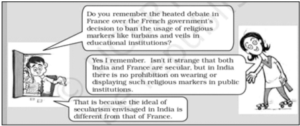
(i) What did the French government ban educational institutions?

Ans. Banning of wearing of turbans, wearing of burqas, religious symbols.

(ii) Is France a Secular State?

Ans. France is the European model of secularism.

(iii) What is the difference between the idea of secularism between France and India?

Ans. France prohibits symbols of religion, not India.

  • You can do publicity of your religion in India but not in France.

Six Marks Questions

Q1. Why to discuss criticism of Indian secularism?

Ans. Anti-religion, from the West, promoting minorityism, interventionist, vote bank politics is an impossible project.

Q2. The emphasis of Indian secularism is not on the separation of religion and states, but more than that, explain this statement.

Ans. To instill a feeling of love, fraternity, unity in people, to preserve integrity, to develop cultural language of minority people.

Q3. Is secularism justified in the following things?

(i) To provide financial grant for the pilgrimage site of minority community?

(ii) To conduct religious rituals in government offices?

Ans.

  • i) Yes, it is justified, so that minorities can spread their religion, and respect the feelings of the economically backward.
  • ii) No, it is against secularism because rituals of a particular religion in government office is against other religions.

We hope that Class 11 Political Science Chapter 8 (Secularism) Important Questions in English helped you. If you have any queries about class 11 Political Science Chapter 8 (Secularism) Important Questions in English or about any other notes of class 11 Political Science in English, so you can comment below. We will reach you as soon as possible…


Share Now on
Category: Class 11 Political Science Important Questions in English

Leave a Reply Cancel reply

Your email address will not be published. Required fields are marked *

Free WhatsApp Group

Free Telegram Group

Our Application

Class 12

  • Class 12 All Video Courses
  • Class 12 All Important Notes 
  • Class 12 All Important Questions
  • Class 12 All Important Quizzes
  • Class 12 All Important Objective Questions
  • Class 12 All Sample Papers
  • Class 12 All Last Year Questions Papers
  • Class 12 All PDF E-books

Class 11

  • Class 11 All Video Courses
  • Class 11 All Important Notes 
  • Class 11 All Important Questions
  • Class 11 All Important Quizzes
  • Class 11 All Important Objective Questions
  • Class 11 All Sample Papers
  • Class 11 All Last Year Questions Papers
  • Class 11 All PDF E-books

Class 10

  • Class 10 All Video Courses
  • Class 10 All Important Notes 
  • Class 10 All Important Questions
  • Class 10 All Important Quizzes
  • Class 10 All Important Objective Questions
  • Class 10 All Sample Papers
  • Class 10 All Last Year Questions Papers
  • Class 10 All PDF E-books

More Important Questions

  • Class 10 English Important Questions (21)
  • Class 10 Important Questions (0)
  • Class 10 Math Important Questions in English (0)
  • Class 10 Science Important Questions in English (0)
  • Class 10 Social Science Important Questions in English (19)
  • Class 11 Economics Important Questions in English (0)
  • Class 11 English Important Questions (16)
  • Class 11 Geography Important Questions in English (22)
  • Class 11 History Important Questions in English (0)
  • Class 11 Home Science Important Questions in English (16)
  • Class 11 Important Questions (0)
  • Class 11 Physical Education Important Questions in English (12)
  • Class 11 Political Science Important Questions in English (20)
  • Class 11 Sociology Important Questions in English (0)
  • Class 12 Economics Important Questions in English (15)
  • Class 12 English Important Questions (22)
  • Class 12 Geography Important Questions in English (18)
  • Class 12 History Important Questions in English (15)
  • Class 12 Home Science Important Questions in English (18)
  • Class 12 Important Questions (0)
  • Class 12 Physical Education Important Questions in English (10)
  • Class 12 Political Science Important Questions in English (18)
  • Class 12 Sociology Important Questions in English (14)
  • Class 9 English Important Questions (42)
  • Class 9 Important Questions (0)
  • Class 9 Math Important Questions in English (0)
  • Class 9 Science Important Questions in English (0)
  • Class 9 Social Science Important Questions in English (21)
  • Uncategorized (0)

Other Important Questions

  • Soils (Ch-6) Important Questions || Class 11 Geography Book 2 Chapter 6 in English ||
  • Natural Vegetation (Ch-5) Important Questions || Class 11 Geography Book 2 Chapter 5 in English ||
  • Climate (Ch-4) Important Questions || Class 11 Geography Book 2 Chapter 4 in English ||
  • Drainage System (Ch-3) Important Questions || Class 11 Geography Book 2 Chapter 3 in English ||
  • Structure and Physiography (Ch-2) Important Questions || Class 11 Geography Book 2 Chapter 2 in English ||
  • India: Location (Ch-1) Important Questions || Class 11 Geography Book 2 Chapter 1 in English ||
  • Biodiversity and Conversation (Ch-16) Important Questions || Class 11 Geography Book 1 Chapter 16 in English ||
  • Life on the Earth (Ch-15) Important Questions || Class 11 Geography Book 1 Chapter 15 in English ||
  • Movements of Ocean Water (Ch-14) Important Questions || Class 11 Geography Book 1 Chapter 14 in English ||
  • Water (Ch-13) Important Questions || Class 11 Geography Book 1 Chapter 13 in English ||
  • World Climate and Climate Change (Ch-12) Important Questions || Class 11 Geography Book 1 Chapter 12 in English ||
  • Water in the Atmosphere (Ch-11) Important Questions || Class 11 Geography Book 1 Chapter 11 in English ||
  • Atmospheric Circulation and Weather Systems (Ch-10) Important Questions || Class 11 Geography Book 1 Chapter 10 in English ||
  • Solar Radiation, Heat Balance and Temperature (Ch-9) Important Questions || Class 11 Geography Book 1 Chapter 9 in English ||
  • Composition and Structure of Atmosphere (Ch-8) Important Questions || Class 11 Geography Book 1 Chapter 8 in English ||
© 2025 Criss Cross Classes | Powered by Minimalist Blog WordPress Theme